
These Apply to All Types
- The generator can be any type or capacity: dynamo, alternator – whatever is available locally to suit the rotor size & local electricity requirements. It can be fitted externally to the rotor for ease of maintenance.
- The rotor is basically an undershot Hydrotor (waterwheel). It can be made of steel, aluminium, wood, or any other material. The paddles, or buckets can be of any suitable design, especially using the Carruthers design which is more efficient.
The Single Type of Buzz Hydro
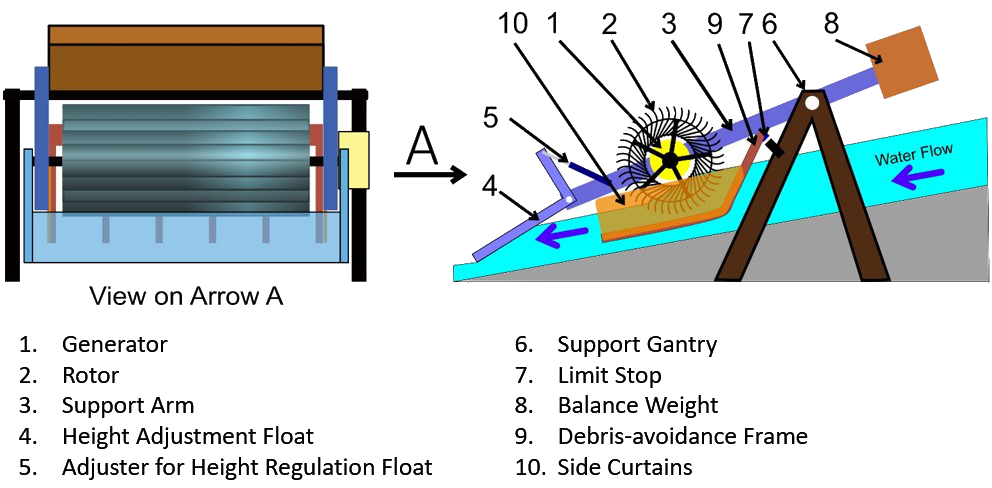
- The Support Arm is a simple structure, steel, aluminium, wood, or any other suitable material. It supports the Rotor, the Height Adjustment Float and the Balance Weight, and is pivotally mounted on the Support Gantry.
- It has a Height Adjustment Float that can be made of any suitable material and is pivotally mounted on the end of the Support Arm. It is designed to “float” on the running water to raise or lower the Support Arm, and therefore the Rotor, to automatically immerse the rotor to an optimum depth for optimum electricity generation.
- The Adjuster for Height Regulation Float alters the angle of the Height Regulation Float so that it can give the optimum depth for the rotor.
- The Support Gantry can be put on the banks of the river or stream. Maybe there is no need for a Support Gantry if it is possible to mount the Support Arm on brackets on an existing bridge, for example.
- The Limit Stop is to prevent the rotor from touching anything solid, like the river bed when the river is low.
- The Balance weight is to partially balance the Support Arm, complete with Rotor, etc, so that the Height regulation Float doesn’t have too big a job to do. The Balance weight can be of any suitable material, of course, including being filled easily with water. It is better that it can be adjusted, either by adding or subtracting weight, or my moving it further away from or nearer to, the Support Arm pivot.
- The Debris-Avoidance Frame is fixed rigidly to the Support Arm. It is illustrated as 6 prongs, and it is as smooth as possible so that any trees, branches, etc, would move underneath and could lift the Support Arm upwards to enable the debris to flow underneath without damaging anything.
- The Side Curtains, fixed to the Debris-Avoidance Frame, are designed to funnel the water into the Hydrotor and help prevent the water from escaping round the ends of the Hydrotor. They could possibly be extended forwards to help increase efficiency.
- Maybe an Underside Curtain, not shown, would help the efficiency even more.
- The idea is that these items are part of the whole unit and would replace the need for any infrastructure on site, apart from mountings for the Support Gantry.
The Array Type of Buzz Hydro
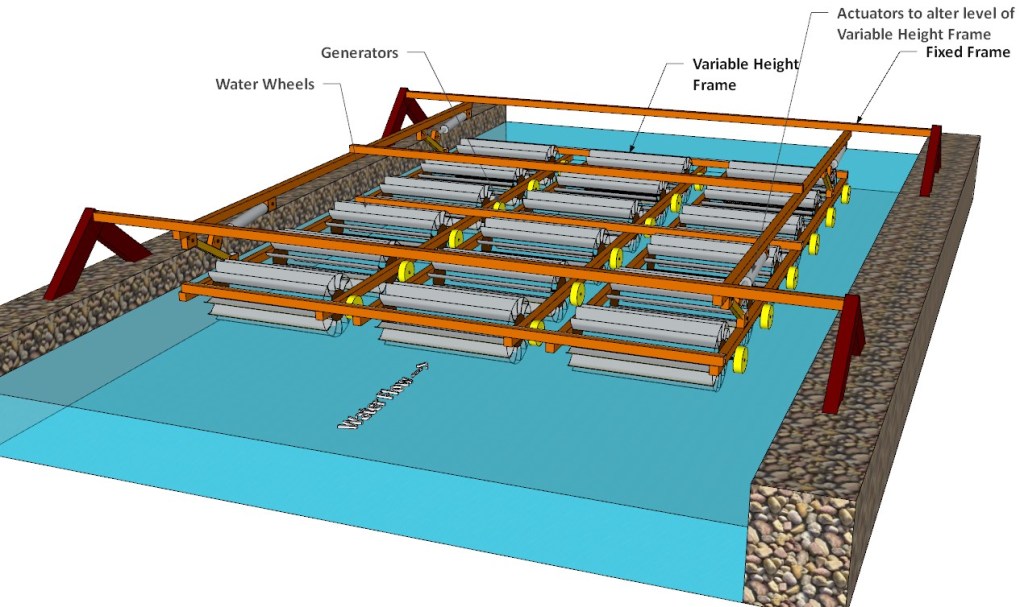
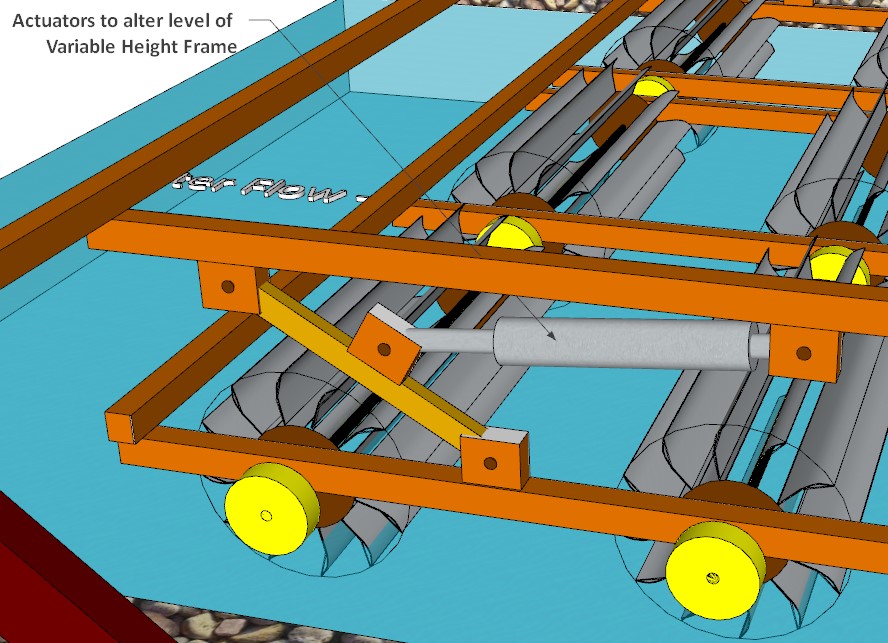
- An array of Hydrotors, as illustrated.
- A Generator on each Hydrotor
- There is a Fixed Frame which is attached to the bank(s) of the river.
- There is a Variable Height Frame attached to the fixed frame by 4 pivoting arms
- Each pivoting arm is moved by an actuator to automatically control the depth of the Hydrotors in the river.
- The actuators are controlled by a water level feedback system.
Parallelogram Array of Hydrotors
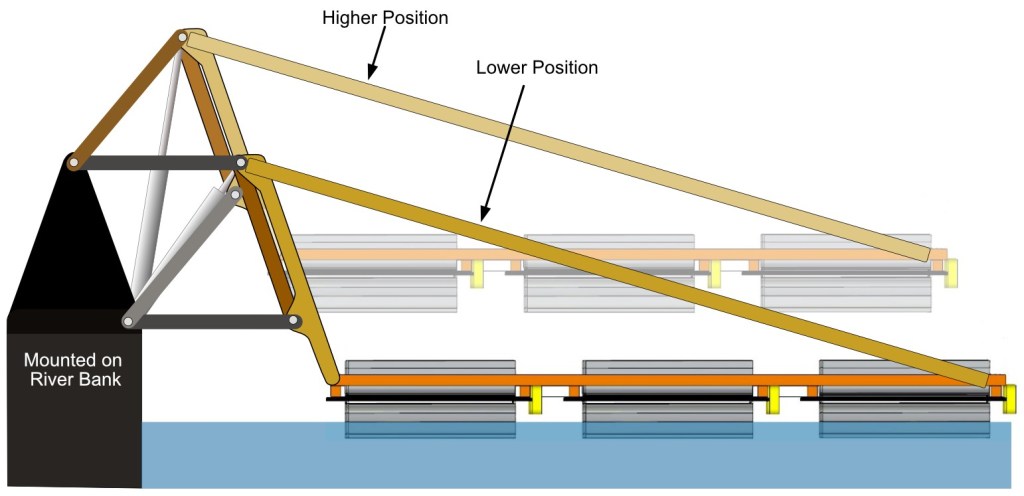
This type raises the array by means of actuators moving a parallelogram depending on the river height.
It also allows, via external means, the whole array frame to pivot up for maintenance, etc. purposes
Pivoting Array of Hydrotors
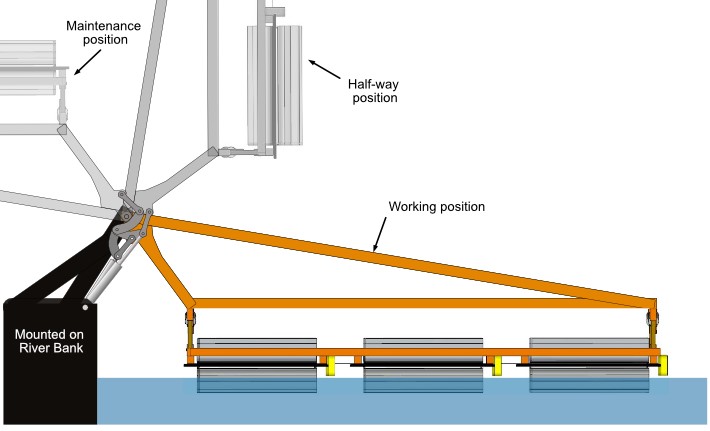
Pivoting Single Hydrotor
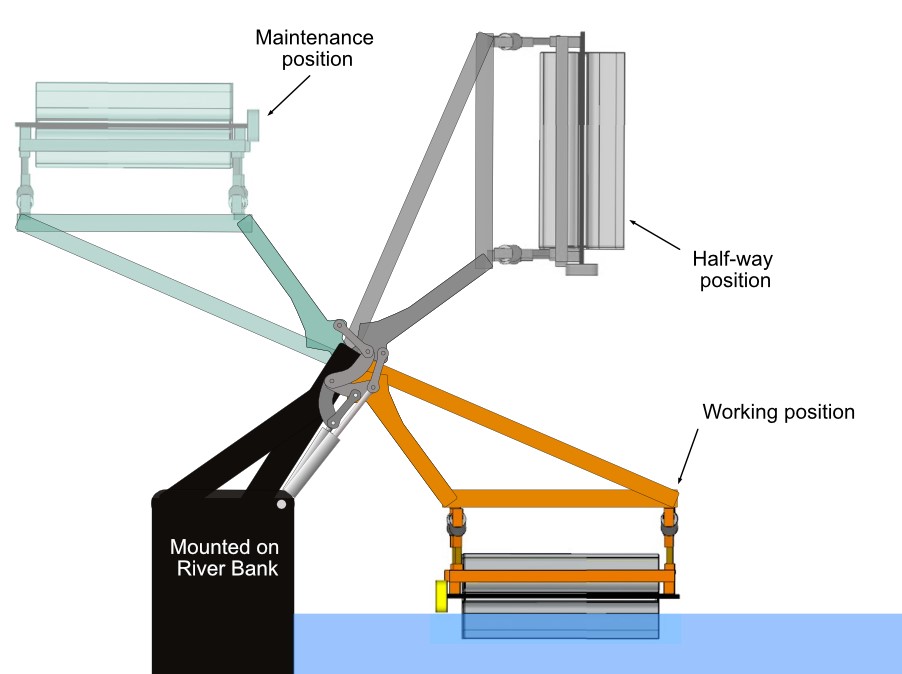
For each of the Pivotting Types:
- An array of Hydrotors, as illustrated.
- A Generator on each Hydrotor
- There is a Frame which is pivoted from the bank of the river.
- There are actuators on the bank mounting that can raise the frame via a pivot through up to 180 degrees, either for debris avoidance or for ease of maintenance.
- There is a Variable Height Frame attached to the pivoting frame by 4 pivoting arms
- Each pivoting arm is moved by an actuator to automatically control the depth of the Hydrotors in the river.
- The actuators are controlled by a water level feedback system.
Single Hydrotor between two Pontoons

In this version, the height of the Hydrotor is automatically adjusted by the floating pontoons.
It can be securely moored, and can have a debris-avoidance frame, side curtains, etc.
 Buzz Hydro --------- The Future of Hydro-Electricity